Before You Dive In
- A school’s ranking tells you less about a neighborhood than the community around that school does.
- Two areas that look nearly identical on paper can feel completely different in person, and the school community is where that difference shows up first.
- A strong, involved school community usually signals stability, low turnover, and pride of ownership, all of which help protect home value.
- This matters even if you will never have a child in the classroom, because you are buying neighbors as much as you are buying a house.
- The best way to understand this is in person: walk by at pickup time, drop in on a community event, and talk to people who already live there.
The better question buyers can ask
Almost every buyer I work with asks me the same thing early on: how are the schools? It is a fair question, and just the beginning of the conversation. Palo Alto’s choice programs are a small but telling example of this. Three elementary schools, Hoover, Ohlone, and Escondido, offer choice programs, including the Mandarin immersion strand at Ohlone and the Spanish immersion strand at Escondido. As the demand for a program outpaces the seats available, a lottery decides admission. That pattern continues at the middle school level, where three schools, JLS, Greene, and Fletcher, carry choice programs forward. Two of those, the Mandarin Bridge and Spanish Bridge programs at Greene, are built specifically to continue the immersion path, and add a language fluency assessment for any student joining without that elementary background.
Rankings and test scores are easy to look up, which is exactly why they tell you so little that your competition does not already know. The question that actually reveals a neighborhood is more nuanced. Not how “good” is the school, but what is the community around it like? That is where a place shows you who it really is.
What the community shows that a ranking cannot
Two neighborhoods can feed schools that look almost the same on a spreadsheet and feel like different worlds the moment you visit them.
A school community is a live readout of the neighborhood around it. When families are deeply involved, when events are well attended, you are looking at a place with low turnover and long memories. People who plan to stay tend to invest in their homes, their front yards, and each other. That shows up on the street as pride of ownership and a certain steadiness you can feel but not quite measure.
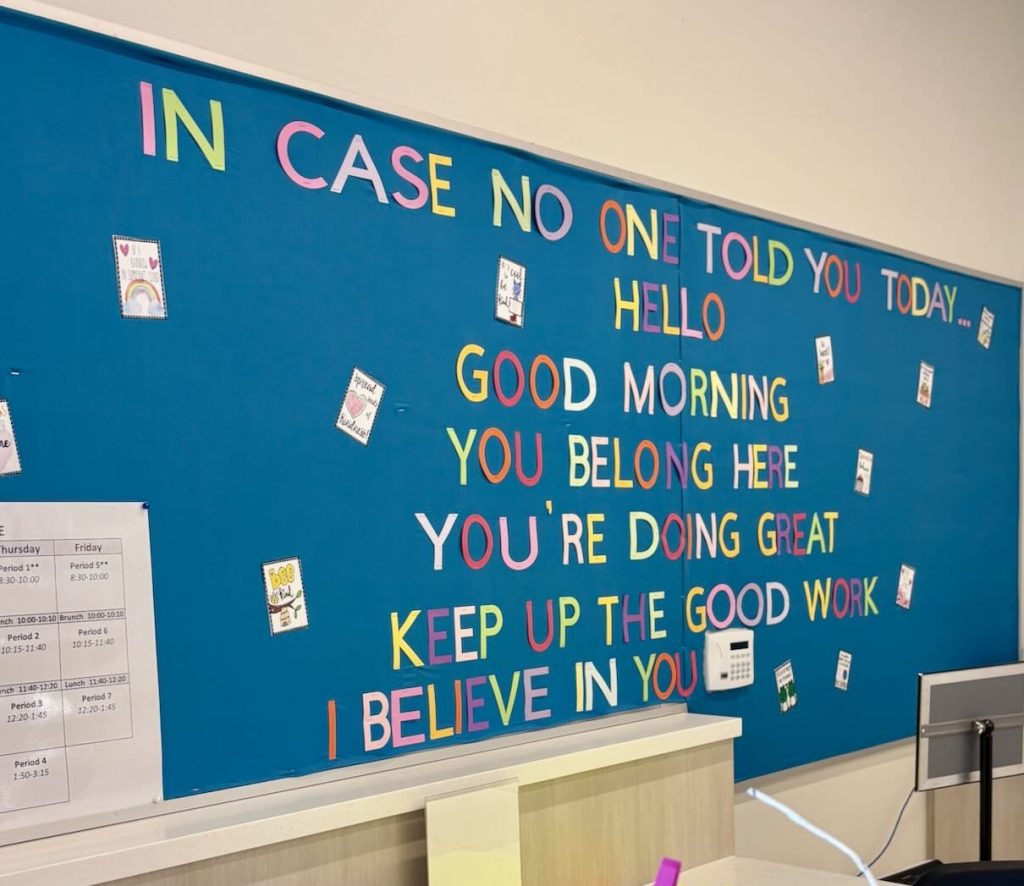
Encouraging words in a Palo Alto school’s front office
“You are not just buying a house. You are buying neighbors, a pace, and a sense of belonging. The school community shows you all three before you sign a thing”
Our own personal experience
I saw this up close through my own daughter. She started kindergarten in the Spanish immersion program at a local school, and within weeks she had a circle of new friends, several of whom already spoke Spanish at home. The school held a small world inside it, families from sixty-five countries were represented there. Today she understands Spanish fluently and speaks it with ease, though the language was never really the whole story. The immersion cohort became close-knit in a way that has outlasted the classroom itself. Even now, as some of those children move on to different schools, those friendships continue. That is not something a ranking could have told me. It only showed itself once we were inside the community, living it.
Why this matters even without kids
Here is the part that surprises the empty-nesters and the buyers who are long past school-age children. The school community is one of the best signals you have, whether or not you will ever set foot in a classroom.
A neighborhood anchored by an engaged school community tends to be stable, and stability is what protects a home’s value over the years. Families who put down roots do not churn through the block every eighteen months. They maintain their homes, they know their neighbors, and they keep the whole area feeling cared for. When you buy there, you are buying into that fabric. You are choosing neighbors, a pace, and a sense of belonging, and those outlast any single school year.
How to actually read it before you buy
You cannot learn this from a listing, so go see it for yourself. It takes an afternoon and it is worth more than a week of online research.
Walk the neighborhood around school pickup time and watch how it moves. Are there kids on bikes and parents chatting on corners, or is it quiet and closed off? Look for the flyers on the coffee shop board, the community events, the signs of a place that gathers. If you can, talk to someone who already lives there. Most people will tell you the truth about their own street if you simply ask. And bring me along. Reading these signals is a large part of what two decades in one community teaches you, and it is exactly the kind of thing I am here to help you see.
The takeaway
Anyone can pull a school ranking. Very few buyers slow down enough to read the community around it, which is precisely why it is such a useful strategy. The number on the page tells you about a school. The life on the street tells you about your future neighborhood. Learn to understand the second one, and you will make a far better decision than the buyer competing against you.
Palo Alto Home Buyer Questions
I do not have kids. Does the school community still matter to me?
Yes, quite a bit. An engaged school community usually demonstrates a stable, low-turnover neighborhood where people invest in their homes and each other, and that steadiness helps protect your home’s value whether or not you ever interact with the school.
How can I get a feel for a school community before I buy?
Visit in person. Walk the area at pickup time, notice whether the neighborhood gathers, look for local events, and talk to people who live there. An afternoon on the street tells you more than hours online.
Are test scores and rankings enough to judge a neighborhood?
They are a starting point, not an answer. Two areas with similar scores can feel completely different in person. The community around the school displays the character and rhythm of daily life that a ranking never will.
Does a strong school community really affect home value?
Indirectly but meaningfully. Engaged, rooted communities tend to have lower turnover and better-kept homes, and that stability is one of the subtle forces that helps a neighborhood hold and grow its value over time.